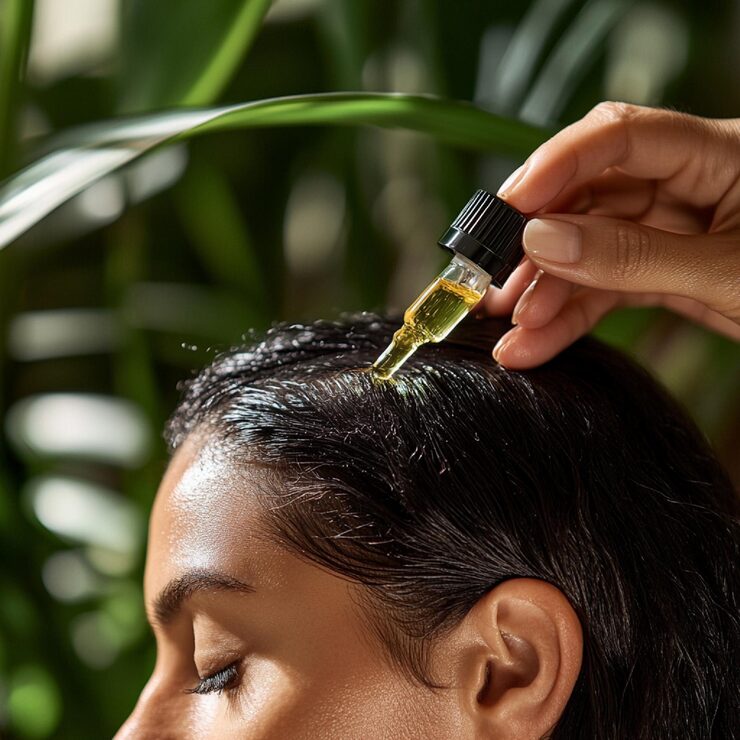
CBD has already worked its way into oils, creams, and serums — hair care was only a matter of time. Shampoos, conditioners, and scalp serums infused with CBD are now fairly easy to find, but the actual case for using it on your hair and scalp is worth understanding before paying a premium for the label.
How CBD Might Actually Help Hair and Scalp Health
- Calming an irritated scalp: CBD has documented anti-inflammatory properties in early research, which is why it’s marketed toward scalp conditions involving redness, flaking, or general irritation.
- Balancing oil production: some research suggests CBD may help regulate sebum, the natural oil produced by the scalp — relevant for anyone dealing with either an overly oily or overly dry scalp, since sebum imbalance can contribute to both.
- Antioxidant support: CBD contains antioxidant compounds that may help protect hair follicles from oxidative stress, a factor some researchers associate with hair thinning over time, though this connection is still an active area of study rather than settled science.
- Moisture retention: CBD hair products are frequently formulated alongside hydrating ingredients like argan oil or shea butter, meaning some of the perceived softness benefit may come from the broader formula rather than CBD specifically.
What CBD Hair Care Isn’t
It’s worth being clear about what CBD hair products are not claiming, or shouldn’t be claiming: there’s no solid clinical evidence that CBD reverses hair loss, regrows hair, or outperforms established treatments for conditions like androgenetic alopecia. Any product making a direct hair-regrowth claim tied specifically to CBD is overstating what the current research actually supports — a calmer, potentially healthier scalp environment is a more realistic and honest expectation.
Reading a CBD Hair Product Label
- Check the CBD concentration: look for an actual milligram amount rather than just the word “CBD” on the front of the bottle — some products contain only trace, marketing-driven amounts.
- Check the full ingredient list: a shampoo loaded with sulfates or harsh alcohols can undercut whatever calming benefit the CBD is meant to provide, especially for a sensitive scalp.
- Look for third-party lab testing: a certificate of analysis (COA) confirms both potency and that the product is free of contaminants like heavy metals or pesticides — the same standard that applies to any other CBD product.
This label-reading approach lines up closely with the broader guidance in our CBD safety guide for responsible adults, which covers the same core checks — potency, ingredients, and lab testing — that apply across CBD products generally, not just hair care specifically.
Who Might Actually Notice a Difference
People with a genuinely irritated, flaky, or reactive scalp are the most likely to notice a real difference from CBD hair products, given the anti-inflammatory association. For hair that’s simply dry, damaged, or brittle from heat styling or coloring, a good moisturizing formula will likely do most of the work regardless of whether CBD is in it — the CBD isn’t hurting, but it’s also probably not the reason a well-formulated conditioner works.
A Practical Way to Test It
Given how individual scalp reactions can be, a patch test on a small area — or simply using a CBD shampoo or scalp serum consistently for two to three weeks — is a more reliable way to judge whether it’s making a real difference than expecting an immediate, dramatic change after a single use. As with most scalp and hair treatments, consistency matters more than any single application.
The Bottom Line
CBD hair care sits in a similar place to CBD skincare: a plausible, calming addition to a routine for people with scalp sensitivity or irritation, not a proven hair-growth treatment. Choosing a well-formulated product with a genuine CBD concentration and clean supporting ingredients matters more than chasing the CBD label alone.
For general guidance on hair and scalp health from a clinical perspective, the American Academy of Dermatology’s hair care guidance is a useful independent reference.